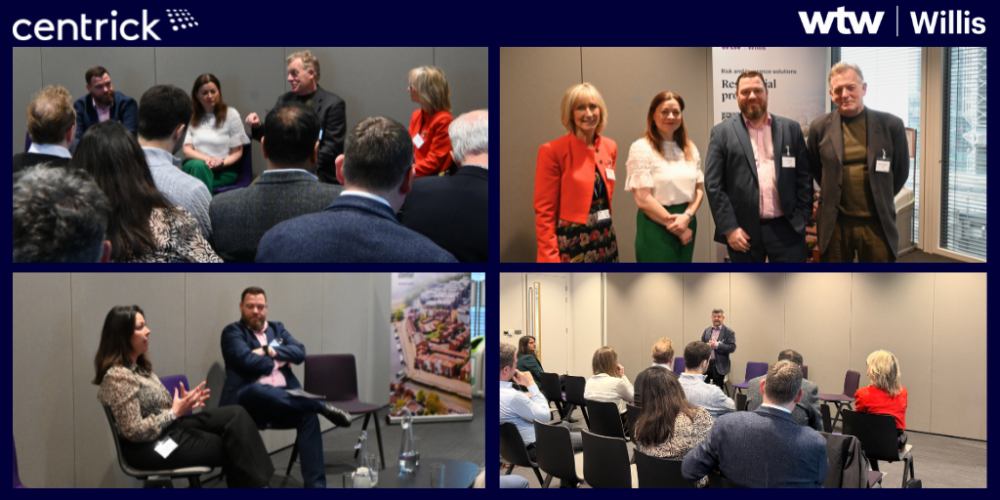
On Tuesday, Centrick partnered with WTW, Knights, and Shared Voice to bring together industry experts for a timely and thought-provoking discussion on the future of UK housing and development. Aptly titled “Blueprint to Brick”, the event was hosted at the prestigious Willis offices in London and focused on the practical realities of delivering safer, more accountable buildings in a post Grenfell BSA landscape.
Our Group Business Director, Jane Morcom, moderated the first panel discussion and Build to Rent Director, Clare Johnson, joined by Shaun Grainger of WTW engaged in a fireside chat on Beyond Construction: Operating the building with BSA.
Our Key Takeaways:
Building Safety Act: Progress Made, But at a Slow Pace
Discussions highlighted how the Building Safety Act (BSA) has reshaped the management of Build to Rent (BTR) assets and the occupation of residential buildings. While progress is evident, it remains gradual. This year marks nine years since the Grenfell tragedy, the catalyst for fundamental change in building safety, and many speakers reflected on the gap between intent and implementation.
The Biggest Impact Over the Past Year: Training, Information, and Accountability
Representatives from Knights, WTW, and ARL shared perspectives on the most significant changes seen in the last 12 months:
- Liz Ramsden (Knights) emphasised that training is critical – ensuring everyone understands their responsibilities and can be held accountable to mitigate heightened risk.
- Shaun Grainger (WTW) pointed to the challenge of managing information effectively across increasingly complex projects.
- Brendan Geraghty (ARL) expressed disappointment at the pace of change and highlighted the urgent need to collaboration from all stakeholders including Building Safety Regulator (BSR). He stressed that competence, not just compliance, is essential – though the two are linked, as compliance ultimately drives competence.
Gateway 2, Capital Markets, and the Data Challenge
Gateway 2 was identified as an area of improvement, but speakers agreed there is still a clear need for greater consistency and clarity of data during the construction and design stages.
Brendan Geraghty (ARL) also highlighted a notable shift in capital markets, underlining the importance of aligning capex and opex. This alignment ensures the right approach to accountability between developers and investors and supports long-term asset performance and safety.
Best Advice for Clients: Treat This as a Long-Term Liability
A recurring message throughout the event was that building safety is a long-term commitment, not a box-ticking exercise.
Key advice included:
- Data must be managed correctly, digitally, and in real time, not captured at a single point in time.
- Any changes to construction, layout, or building systems must be clearly recorded, particularly when approaching Gateway 3.
- Building contracts need to be brought fully into the scope of the Act.
- Resident engagement is critical, as is future-proofing assets for long-term investment.
- Accountability must be shared across all stakeholders, not placed solely on the managing agent, to ensure buildings remain safe for residents throughout their lifecycle.
Data, Design, and the Golden Thread
A panel featuring Tim Quick (Formation Architects), Rupert Parker (Building Passport), and Flora McDougall (Firethorn Trust) explored improvements following Andy Rowe’s leadership at the BSR, including reduced safety case approval times of approximately 18–19 weeks.
Key takeaways included:
- Modular construction may offer a more efficient route through the gateways due to standardised data.
- Earlier data gathering, with wider stakeholder involvement, significantly speeds up processes and improves accountability.
- There remains a disconnect between planning, design, and gateway progression, compounded by the depth of information now required – far greater than initially anticipated.
- Building Passport was highlighted as a powerful tool for real-time data management, providing a full audit trail of updates and interactions, improving transparency and supporting the ongoing management of the golden thread.
Sharing Operational Data: A Managing Agent’s Perspective
During a Centrick fireside chat on the impact of BSA amendments on residential building management, Clare Johnson (Centrick) shared that while legislation has evolved, Centrick’s core approach has not.
Ensuring buildings are safe for residents has always been a priority. The key difference now is earlier engagement across all stakeholders involved in developing safer homes. Centrick’s dedicated Building Safety Team supports operational building management, ensuring client assets are fully compliant with accountability for managing the golden thread.
Crucially, this approach doesn’t just reduce risk – it has been proven to add value to buildings, future-proofing assets for clients and leaseholders alike.