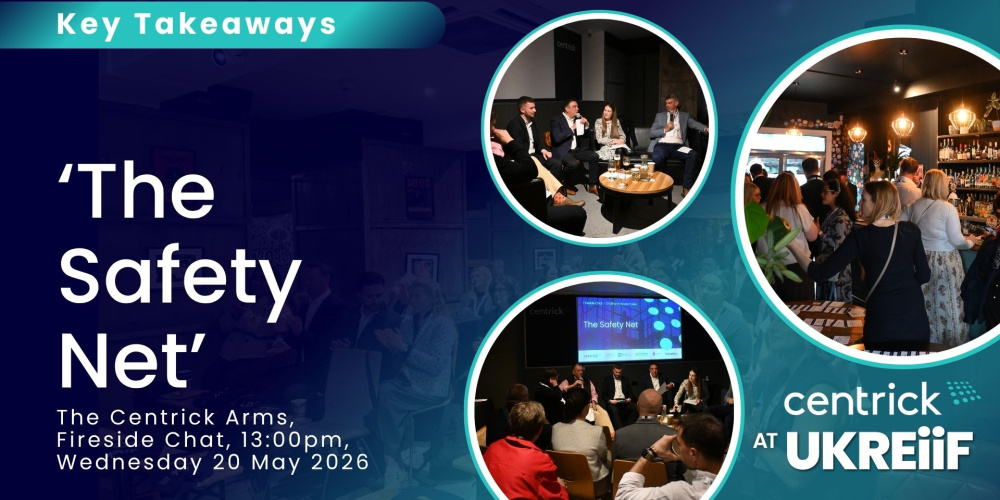
‘The Centrick Arms’ at UKREiiF 2026: ‘The Safety Net’ Fireside Chat – Key Takeaways
By early afternoon, the conversation had shifted from talent and planning to territory that felt more urgent still. Building safety, compliance and the commercial realities that now surround both were the focus of Centrick’s third fringe session of the day, moderated by Phil Johns, Managing Director at Centrick. The panel brought together expertise spanning building safety management, fire risk assessment, legal practice, investment strategy and operational asset management.
The opening exchange did not soften the landing. The Building Safety Act is creating friction well beyond the buildings it was designed to protect. Acquisitions are stalling. Asset disposals are being delayed because the surveys required to transact are intrusive, and the accountability that flows from commissioning them means nobody wants to act on what they find. Costs across the board have increased significantly. And in some cases, the people responsible for making decisions, RMC directors, accountable persons, building owners, are looking at rising service charges and concluding that something has gone wrong, when in many cases the complexity and cost of operating these buildings is simply being reflected honestly for the first time.
The duty to engage
On resident engagement, the discussion centred around the statutory duty introduced by the Building Safety Act. This is clear in principle and genuinely difficult in practice. Early experience in the room told its own story: resident response rates starting vanishingly low, improving only once dedicated resource was put behind the effort. Drop-in sessions, cleaner communication and committed team capacity all made a difference. But that takes investment, and not everyone can make it.
The question of what constitutes reasonable engagement remains largely unanswered. Nobody will know until decisions are tested in retrospect, and that uncertainty lands very differently depending on the size of the organisation. Larger managing agents with dedicated building safety teams can absorb it. Smaller operators managing higher-risk buildings without that infrastructure are carrying a risk that the sector is not speaking about loudly enough.
The panel highlighted that this is not only a small-agent problem. Frankness is lacking across the industry, and there is a case for the sector to speak more openly about what genuine compliance actually costs, rather than absorbing the pressure quietly and hoping the question does not get asked.
The conversation on fire risk assessment carried similar weight. Most assessors are in the role because they care deeply about the safety of the people living in the buildings they assess. But competence in writing a fire risk assessment and competence in reading and acting on one are two different things. The sector has focused considerable energy on the former. The latter, ensuring that the people interpreting and acting on reports have sufficient training to do so properly, has received less attention. Decision paralysis is a real problem. Reports land, actions are identified, and sometimes nothing happens because nobody is willing to take ownership. A good assessor will support their clients in understanding what a report means and what it requires, and in many cases that support is available at no additional cost.
On personal accountability, the panel was equally direct. Accountable persons and principal dutyholders exist in significant numbers across the sector who do not fully understand that they are personally exposed to unlimited fines. The legislation attributes responsibility in ways that do not always tally with how buildings are actually managed. The overlap between the accountable person framework and the responsible person under fire safety law remains unnecessarily complex, and the panel’s view was that it did not need to be that way.
Tribunal enforcement is inconsistent. The sector is seeing a significant and growing volume of cases year on year. There are early signs that decision-makers are becoming more receptive to well-evidenced explanations of why costs have risen, but the picture remains uneven. The panel also pointed to the role of supply chain partners in supporting compliance, with tools such as building passports offering a way for the wider network to contribute to safety management systems, rather than leaving the burden entirely with the managing agent or investor.
Two kinds of competence
From an investment and cost planning perspective, the data being gathered across the sector tells a clear story. Costs have increased materially since the Building Safety Act came into force, driven by requirements that simply did not exist when many planned preventative maintenance schedules and service charge budgets were set: quarterly fire door checks, building safety case reports, fire risk appraisals of external walls. A further complication is the persistent misunderstanding among some leaseholders that they are not required to contribute to remediation costs at all, without realising that exemption applies only to external wall remediation.
The picture, however, is not uniformly negative. The sector is in a considerably better position than it was ten years ago, and property management companies have been a meaningful part of that improvement. One concern identified is that some buildings are still being constructed and remediated to a standard that falls short of what the legislation intended, and that gap has not closed as much as it should have.
On whether the cost of compliance can be mitigated through smarter procurement elsewhere, the panel’s view was nuanced. There is a meaningful difference between cutting corners on fire safety and achieving economies of scale through strategic sourcing. The former is not an option. The latter is, and the operational stack beyond fire safety, including security, soft services and access control, offers genuine scope for efficiency that can help rebalance the overall picture. The challenge put to the room was to be honest about the cost of fire safety and why it is materially higher than it was five years ago, rather than looking for ways to make that cost disappear, with the feeling that it is likely to take something going wrong before the full consequences of cost-cutting in this area become visible. The sector should not wait for that moment.
What the sector still hasn’t learned
The closing question: What lesson from the last few years has the industry still not properly learned, drew the most reflective responses of the session. Several contributions pointed to legislation that was rushed, with the consequences of poor drafting continuing to make delivery harder than it needs to be. Competence remains a problem, with contractors, consultants and managing agents still operating in spaces they are not adequately equipped for, and the pace of upskilling is not keeping up with what the regulatory environment now demands. There is also a significant amount of hostility between stakeholders that makes collaboration harder and slows progress.
One contribution offered a different frame. The Building Safety Act and the Renters Rights Act, for all the disruption they bring, have made it legally explicit that resident safety and resident experience are not optional. For an industry that has not always treated both as priorities, that is a meaningful shift. The session closed on a pointed note. Those working in the sector need specialists to guide them through complexity they cannot navigate alone, and government needs to take ownership of the consequences of the legislation it has introduced, rather than leaving the industry to absorb them without adequate support.