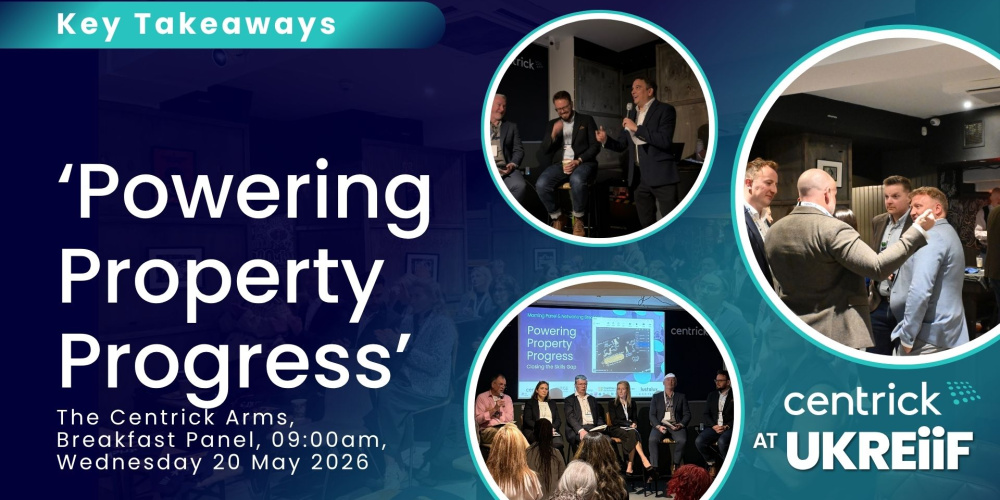
‘The Centrick Arms’ at UKREiiF 2026: ‘Powering Property Progress’ Breakfast Panel – Key Takeaways
Is the property sector correctly diagnosing its own talent crisis? That was the question put to a packed breakfast panel at Centrick’s UKREiiF fringe event on Wednesday (20 May 2026) morning, and the answer, as the discussion quickly made clear, is more complicated than most people in the room had expected.
Phil Johns, Managing Director at Centrick and moderator for the session, opened with a reflection on recent operational experience. When teams are required to respond at pace to complex, high-stakes situations in residential buildings, drawing simultaneously on compliance knowledge, communications, contractor management and resident welfare, it raises a serious question about whether the sector’s current model of professional development is built for that reality.
The panel, which brought together voices from property management, legal practice, learning and development, fire safety and architecture, did not take long to find common ground. Ian Fletcher of The Property Institute was direct. The sector’s core problem, he proposed, comes down to a single word: consistency. Across organisations and across the sector as a whole, it remains the thing most difficult to achieve and most damaging when absent.
A role that has expanded into five
Sarah Hammond, Building and Estate Management Director at Centrick, put it plainly. The role of a property manager today looks almost nothing like it did ten years ago. Resident engagement, compliance, crisis response, contractor oversight, financial management, customer service: what was once a broadly defined role has expanded into four or five distinct disciplines. The sector, she argued, has not kept pace with that shift. The result is not a capability failure but a structural one, and the most talented, committed people in the industry are feeling that pressure acutely.
Joe Milton, Centrick’s Learning and Development Manager, described the work of Centrick Academy in meeting that challenge from the inside. The principle, he said, is to anticipate what skills the business and the sector will need before they become urgent, and to build capability ahead of the curve rather than in response to crisis. Not every solution has to be a formal qualification. Sometimes, he noted, a good conversation over coffee can make a bigger dent than a structured programme.
Watch our UKREiiF 2026 breakfast panel come to life in real time. Live illustrator Jess Ringels captured the entire conversation from Powering Property Progress: Closing the Skills Gap as it unfolded at The Centrick Arms, Centrick’s fringe event at UKREiiF 2026.
Mark Field from Cardinus Risk Management brought a sharp perspective on fire risk assessment specifically. Many practitioners, he observed, arrive in the field through circumstance rather than design, former fire service professionals, people who fell into the role, rather than through any deliberate training pipeline. Government is consulting on what competence in the field should look like, but the honest answer, he suggested, is that the sector is nowhere near where it needs to be, at a time when the buildings being assessed are only growing more complex.
Michael Smith of Bailey Partnership widened the lens to digital adoption and Building Information Modelling (BIM). The industry, he put forward, is not doing enough to train people for the sector it is becoming. Accountability and the golden thread, principles central to the Building Safety Act, demand a more collaborative model in which architects, principal accountable persons and managing agents all understand each other’s role and hold each other to account. No single practitioner can carry that alone.
Leigh Shapiro of Winckworth Sherwood, drew attention to a skills gap that sits on the consumer side rather than the professional one. As commonhold reform accelerates and more leaseholders take on governance and management responsibilities, a growing number of people with no formal training will find themselves legally accountable for decisions that, in any other context, would demand professional knowledge. The sector, she argued, needs to plan for that, and quickly. As she put it, you would not drive a car off the forecourt without understanding how the windscreen wipers work.
The case for investment
The closing question, what one structural change would each panellist make, and what is actually stopping it, drew the clearest answer of the morning. Investment in people. Bailey Partnership described working with local colleges and building capability internally as a deliberate, non-negotiable commitment. Phil Johns noted that meaningful investment in structured learning, including Centrick’s own internal Academy, reflects a belief that training is not a cost to be minimised but a foundation for the quality of service the sector needs to deliver.
And beneath all of it, a quieter theme. Phil closed with a reflection on what he called “competent incompetence”. The importance of creating a culture where people feel safe to say they do not know something, to ask the question, to seek help. In a sector where the stakes have never been higher and the job has never been broader, that might be the most important skill of all.